If you've spent any time around longevity science, you've seen three letters everywhere: NMN. Nicotinamide mononucleotide is not a synthetic invention or a marketing construct — it's a molecule your own body produces and uses every day, and it sits one enzymatic step away from one of the most important compounds in your cells.
What NMN actually is
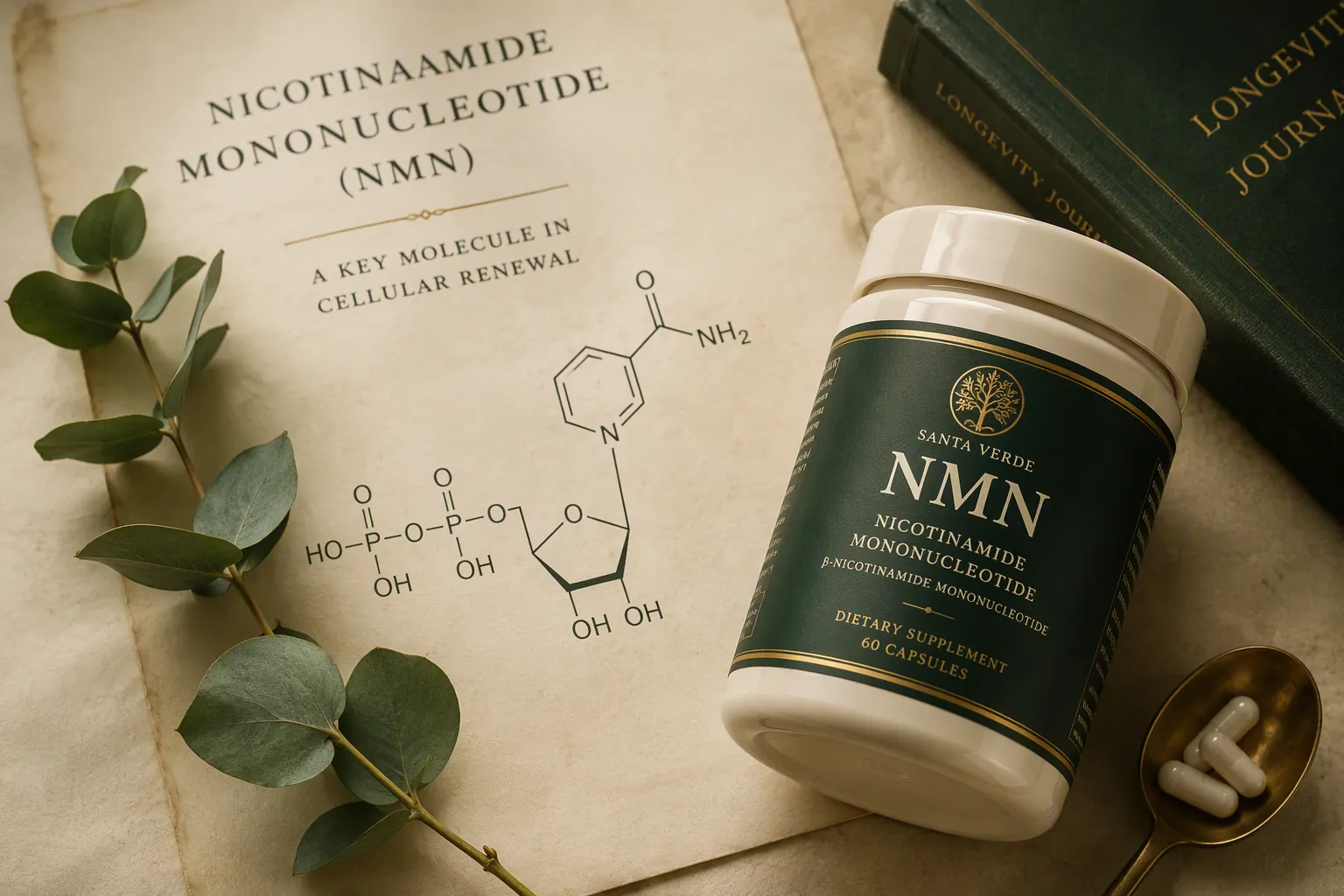
NMN is a derivative of vitamin B3 (niacin). Chemically, it's a nucleotide: a small molecule built from a nicotinamide base, a ribose sugar, and a phosphate group. Your cells manufacture it naturally from dietary precursors, and it also occurs in trace amounts in foods like edamame, broccoli, avocado, and cabbage — though at levels far below what supplementation provides. You would need to eat implausibly large quantities of these foods to match a single 250 mg serving.
NMN's entire significance comes from what it becomes: NAD⁺ (nicotinamide adenine dinucleotide). NMN is the most direct precursor on the main salvage pathway your cells use to produce NAD⁺ — one enzyme (NAMPT feeds into NMNAT) stands between NMN and the finished coenzyme.
Why NAD⁺ declines with age
NAD⁺ is a coenzyme involved in hundreds of metabolic reactions. Two of its jobs matter most for healthy aging:
- Energy production. NAD⁺ shuttles electrons in the mitochondria — the process that converts food into ATP, your cells' usable energy currency.
- Cellular maintenance. NAD⁺ is the required fuel for sirtuins and PARPs — enzyme families involved in DNA repair, inflammation regulation, and stress resistance. They literally consume NAD⁺ to do their work.
Here's the problem: NAD⁺ levels fall substantially as we age — research suggests middle-aged adults may have roughly half the NAD⁺ of young adults. Demand rises (more cellular damage to repair) while supply falls. Researchers describe this as a systemic energy-and-maintenance shortfall, and it's associated with many hallmarks of aging: flagging energy, slower recovery, metabolic inflexibility, cognitive dullness.
Think of NAD⁺ as the electrical grid of your cells. NMN is the most direct way to put more power back on that grid.
How NMN works in the body
When you take NMN, it's absorbed in the small intestine — a dedicated transporter (Slc12a8, identified in 2019) helps shuttle it into cells — where it's converted to NAD⁺ within minutes. Human pharmacokinetic studies confirm that oral NMN reliably and dose-dependently raises blood NAD⁺ concentrations.
What happens next is the interesting part: with more NAD⁺ available, mitochondria run closer to their youthful capacity, and sirtuins get the fuel they need for repair work. This is why NMN users typically describe effects in terms of capacity — energy that lasts the whole day, faster bounce-back from exercise, clearer mornings — rather than a stimulant-like buzz.
What human research shows
It's important to be precise here. Much of the dramatic lifespan research was done in mice. Human trials are smaller and newer — but they exist, they're randomized and placebo-controlled, and their results are consistently encouraging:
- Multiple trials confirm oral NMN (250–1,200 mg/day) significantly elevates blood NAD⁺ and is well tolerated.
- Studies in older adults have reported improvements in physical performance markers — walking speed, grip strength, endurance — versus placebo.
- Trial participants have shown improvements in metabolic markers, including insulin sensitivity in prediabetic women and measures of aerobic capacity in recreational runners.
- Sleep quality and subjective fatigue scores improved versus placebo in several trials in older populations.
Regulatory momentum has followed the evidence. In late 2025 the U.S. FDA confirmed NMN is not excluded from the legal definition of a dietary supplement, and in 2026 the European Food Safety Authority issued a favorable safety opinion for high-purity (≥99%) β-NMN at up to 300 mg/day. NMN has moved from gray-area molecule to an increasingly established category.
The honest summary: NMN reliably raises NAD⁺ in humans, with an excellent safety record in trials so far. Benefits like energy, recovery, and metabolic support are plausible and reported — but NMN is a long-game cellular-health supplement, not an overnight transformation.
Choosing a quality NMN
The market's rapid growth attracted low-quality products — independent testing has repeatedly found marketplace NMN products containing far less than their label claim, sometimes none at all. Quality markers that actually matter:
- Named, traceable raw material (we use Uthever®, the most clinically studied NMN ingredient).
- ≥99% purity, verified by third-party HPLC testing — batch-specific certificates, not generic claims.
- Meaningful doses — 250–1,000 mg per serving, matching studied ranges.
- Clean formulation — no unnecessary fillers; stability-protected (NMN degrades with heat and moisture).
Our Pure NMN Capsules deliver 1,000 mg per serving, and the Pure NMN Powder is the most economical route to a full daily gram. Whichever form you choose, the rule is the same: daily consistency beats occasional megadoses.