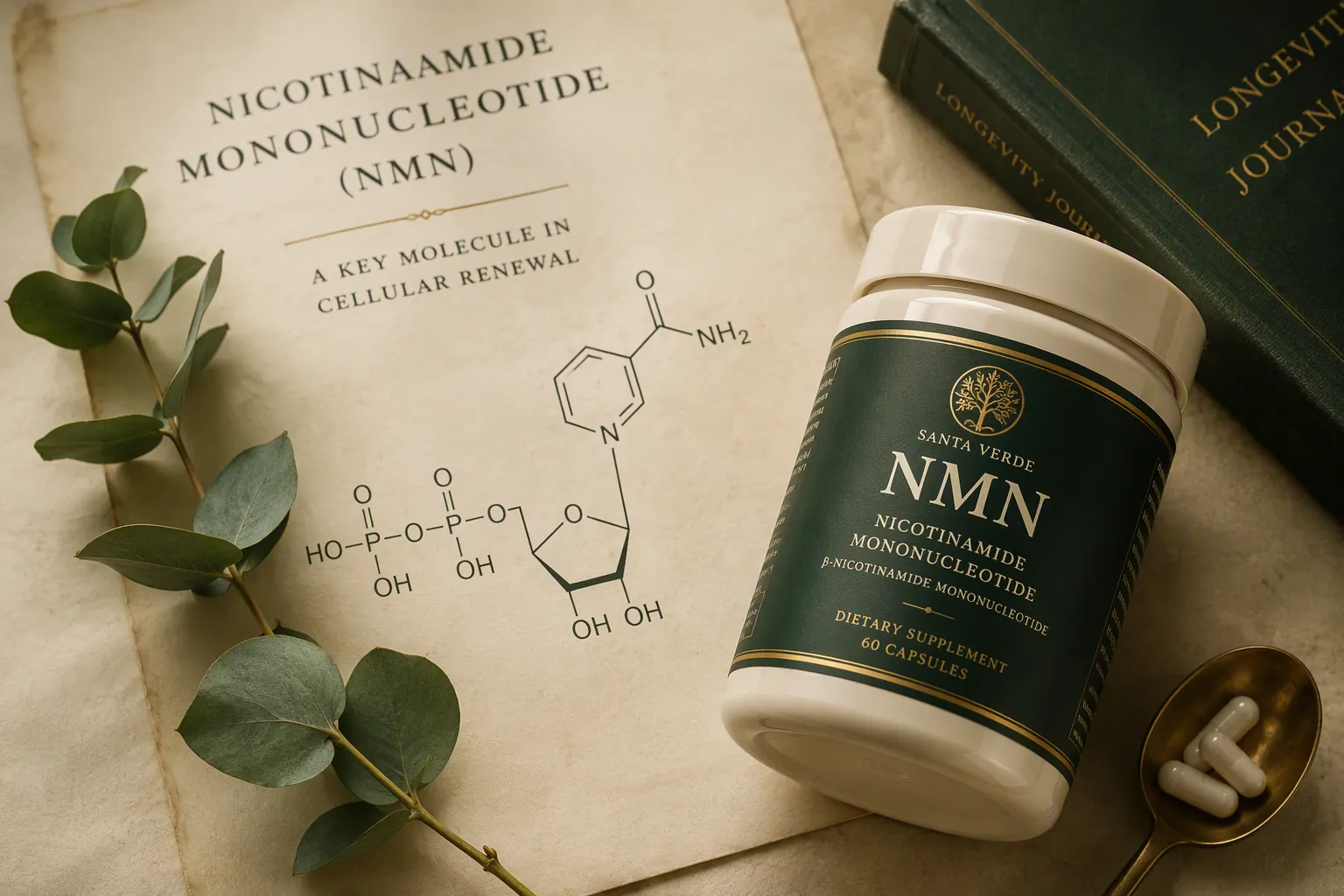
If you're shopping for an NAD⁺ booster, you've narrowed it to two molecules: NMN (nicotinamide mononucleotide) and NR (nicotinamide riboside). Both are vitamin B3-family precursors. Both demonstrably raise NAD⁺ in humans. So which one deserves your money?
Same goal, different routes
Your cells rebuild NAD⁺ through the "salvage pathway," recycling vitamin B3 derivatives back into fresh coenzyme. NR and NMN are neighboring stops on that line: NR is converted into NMN (by enzymes called NRKs), and NMN is then converted into NAD⁺ (by NMNAT enzymes). In other words, NMN is one step closer to the finished product — NR must become NMN first.
The pathway argument
Because NMN sits downstream of NR, NMN advocates argue it skips a conversion step that can be rate-limited in some tissues. NR advocates countered for years that NMN was too large to enter cells directly and had to be broken down to NR first — a fair objection until 2019, when researchers identified a dedicated NMN transporter (Slc12a8) in the small intestine, showing NMN can be absorbed as-is.
The current scientific consensus: both molecules work, both raise NAD⁺, and tissue-level differences are still being mapped. The pathway debate matters less than it once did — but it no longer counts against NMN.
Comparing the human evidence
NR had a head start in human trials, and its track record is genuinely good: repeated studies show NR raises NAD⁺ and is safe. NMN's human literature has since caught up quickly, with randomized controlled trials reporting:
- Dose-dependent NAD⁺ elevation at 250–1,200 mg/day.
- Improved physical performance measures (endurance, gait speed, grip strength) in older adults versus placebo.
- Improved insulin sensitivity in a trial of prediabetic women.
- Better sleep quality and reduced drowsiness scores in older participants.
NR's trials show similarly consistent NAD⁺ elevation, with mixed results on functional outcomes. A fair summary: on NAD⁺ elevation, it's a draw; on functional human outcomes, NMN's recent trial results have been somewhat more consistent — though larger head-to-head trials would settle it properly.
Practical differences
| NMN | NR | |
|---|---|---|
| Steps from NAD⁺ | 1 (direct precursor) | 2 (converts to NMN first) |
| Typical studied dose | 250–1,200 mg/day | 300–1,000 mg/day |
| Human NAD⁺ elevation | Confirmed, dose-dependent | Confirmed, dose-dependent |
| Stability | Good when protected from heat/moisture (microencapsulation helps) | Good; chloride salt form is shelf-stable |
| Cost per gram (typical) | Has fallen sharply — now competitive | Often higher due to patent history |
For years NR held a price and availability advantage. That era is over — enzymatic synthesis scaled up, and high-purity NMN is now affordable: our 500 g powder brings a full daily gram below $0.80/day.
Our verdict
If both raise NAD⁺ reliably, choose on evidence trajectory, dose economics, and what you'll actually take every day. On all three, we give NMN the edge — it's why it's the only NAD⁺ precursor we sell.
If you're already taking NR and happy with it, there's no urgent reason to switch. If you're starting fresh, start with the molecule one step from the goal: Pure NMN Capsules for convenience, or the NMN + Resveratrol + TMG blend if you want the full stack. And whichever you choose, give it a fair trial: NAD⁺ restoration is cumulative — judge after 60–90 days, not 6.